
For detailed information, other images and documents, please select individual articles from the following table.

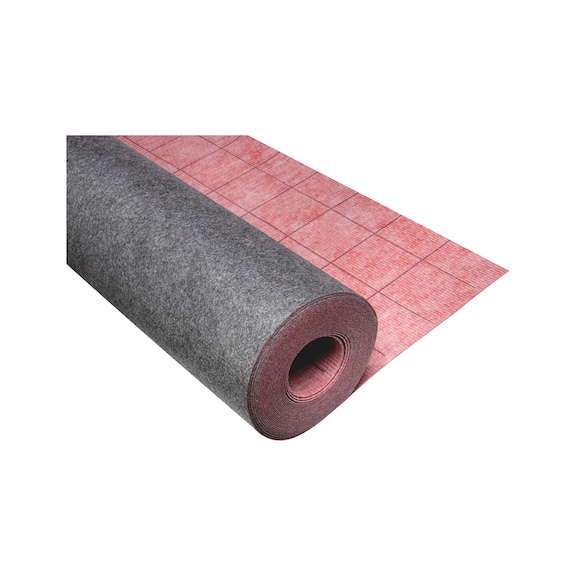
CERAfix 325 STRONG waterproofing and uncoupling membrane
For use as an uncoupling membrane under tiles and slab coverings for uncoupling categories EK-H, EK-G, EK-W and EK-M.

Register now and access more than 125,000 products

Variants
- Watertight
- Easy to apply
- Bridges cracks
- Uncoupling effect
- Reduces footfall sound
- Resistant to chemicals
CERAfix 325 Strong involves a special construction method. We therefore recommend obtaining a contractual and written agreement to use it.
Before applying CERAfix 325 Strong, spread a contact layer with CERAfix 300/301 on existing load-bearing tile substrates and allow to harden!
CERAfix 325 Strong is not suitable for high dynamic loads such as industrial traffic!
CERAfix 300/301/SMP Sprint can be used to seal suitable edge and gutter elements. In this case, the substrate must be prepared in a suitable manner, e.g.: Direct contact with metals such as copper, zinc and aluminium must be prevented by means of pore-tight priming with CERAfix 103/203 and TEGAfix quartz sand. Pore-tight priming is produced in two stages with CERAfix 203 or CERAfix 103. The first stage involves liberal application to the substrate cleaned with acetone (check compatibility) and careful coating. Once this layer has reacted sufficiently so that it can no longer be disturbed (about 3-6 hours*), another epoxy resin layer is applied and scattered with TEGAfix 430 quartz sand. Consumption approx. 800 g/m². A connection to the surface seal is then formed over the cured blinding layer, e.g. using CERAfix 316 sealing tape with CERAfix 300/301/SMP Sprint.
To uncouple wooden substrates, we recommend using CERAfix 206 uncoupling panels.
Edge, field, building and movement joints must be retained or incorporated at the specified locations and sealed by suitable means, e.g. edge insulation strips! Dummy joints must be friction-locked or secured against height offset and formed as a movement joint in the surface covering.
CERAfix 325 must not be adhered or worked over with solvent-containing products!
On cool, damp substrates and in rooms with high humidity and/or low temperatures, an extended drying time should be anticipated for the structure. In such cases, the product will take longer to reach a load-bearing state, including resistance to water.
Protect the CERAfix 325 construction from the effects of water and freezing in the installed state until it has completely dried; this will take longer in unfavourable weather conditions compared to normal conditions*.
The relevant applicable technical information sheets of the indicated products must be observed!
Currently applicable regulations must be observed! For example:
- DIN 18157
- DIN 18352
- DIN 18560
- DIN EN 13813
- DIN 18202
- DIN 1055
BEB information sheets, published by Bundesverband
Estrich und Belag e. V. (Federal Association for Screeds and Coverings) "Interface coordination for heated floor constructions"
ZDB information sheets, published by the German Tiling Industry Association:
- [*1] "Compound sealing"
- [*2] "Coverings on calcium sulphate screed"
- [*3] "Movement joints in tile and slab facings and coverings"
- [*5] "Ceramic tiles and slabs, natural dimension stone and artificial dimension stone on cement-bound floor structures with insulation layers"
- [*6] "Ceramic tiles and slabs, natural dimension stone and artificial dimension stone on heated cement-bound floor structures"
- [*7] "Outer coverings"
- Suitable as compound sealing for water exposure classes W0-I to W2-I in accordance with DIN 18534.
- Can be used on recently laid cement screeds that can be walked on.
- Can be used on floor surfaces with heated and unheated substrates.
- Suitable for indoor and outdoor use.
- Suitable substrates: Engineered woods, dry screeds, cavity floors, concrete, cement screed (CT), floor-levelling compounds, calcium sulphate screeds (CA, CAF), poured asphalt screeds (AS), magnesia screeds (MA), firmly adhered tile coverings
Before starting work, the substrate must meet the following requirements
- Dry
- Load-bearing
- Flat
- Closed surface
- Free from negative water pressure
- Free from adhesion-impairing substances
- Rigid and free from vibrations
Preparing the surface
- Check the substrate and use the CM method to determine the residual moisture.
- Remove impurities, adhesion-impairing substances, bonding agent accumulation/sinter layers.
- Prime absorbent substrates.
- Clean and prime non-absorbent substrates.
- Before laying, level any substrate unevenness using a mineral filler suitable for the application.
Select RAL-colour code
!! NOTE: On-screen visualisation of the colour differs from real colour shade!!