


For detailed information, other images and documents, please select individual articles from the following table.


Repair layer
For simple repairs to small and large surfaces, both indoors and outdoors

Register now and access more than 125,000 products
Variants
Silicone base
- Retains long-term elasticity in extreme weather conditions and does not become brittle
- UV- and weather-resistant
- Solvent-free
Bridges cracks
A layer thickness of 2-3 mm is achieved with just one application.
Easy to apply
Can be applied with a brush, short-pile roller or trowel.
Easy cleaning
Hands, clothing, tools and contaminated surrounding areas can be cleaned with water.
Compatible with bitumen
Not suitable for areas permanently exposed to water (e.g. fountains, cisterns).
The usage instructions are recommendations based on the tests we have conducted and our experience. Carry out your own tests before each application. Due to the large number of applications as well as storage and usage conditions, we do not assume any liability for a specific application result. Any technical information or advice provided by our free customer service shall be provided to the exclusion of any liability, unless the advice or information is part of our contractually agreed scope of services or the advisor was acting wilfully. We ensure the consistent quality of our products. We reserve the right to make technical changes and further developments to our products.
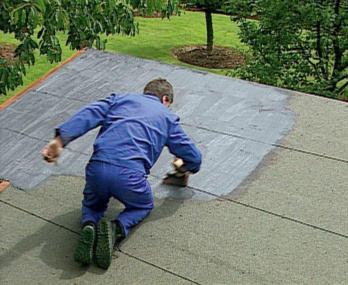
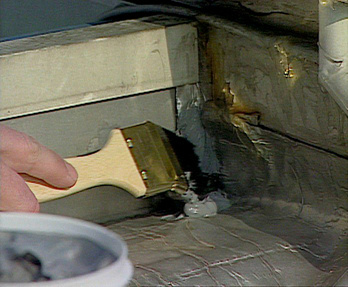
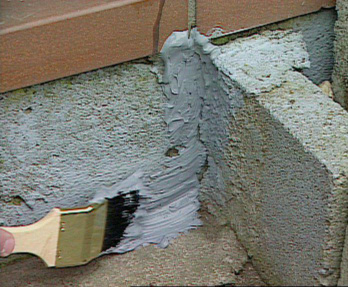
The repair layer is suitable for smaller and larger surfaces for indoor and outdoor use, and protects against weathering, decay and damage caused by humidity. The coating is ideal for repairing eaves gutters, holes and tears in roof sheeting, roofing tiles, in walls, in water channels, roof windows and window openings, balconies and terraces.
For use on:
- Mineral base materials, e.g. concrete, screed, fibre cement sheets, roof tiles
- Bituminous base materials, e.g. roof sheeting and paints
- Acrylate roof coatings
- Metals, e.g. copper, zinc, VA sheet steel, aluminium, stainless steel, brass
- Plastics, e.g. connections to ventilations, drains or light dome skylight bases
- Thermal insulation, e.g. PUR, EPS, extruded polystyrene
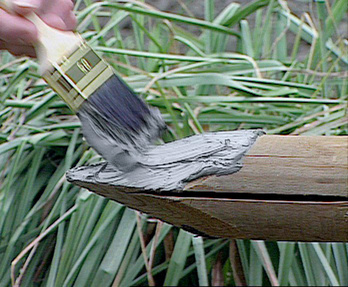
- Wood, e.g. solid wood, OSB, plywood
- Glass, tiles, PU foam, expandable polystyrene
The surface must be load-bearing, clean, free from dust and grease as well as being dry or slightly damp (max. 5 % residual moisture). Remove moss, algae and lichen as well as loose parts and primer mechanically. The repair layer is ready for application. Once the surface has been prepared, apply an even, undiluted, thick layer directly to the surface using a brush, roller, wide brush or short-pile velour roller
within the specified application temperature range. A wet application layer of at least 3 mm to 5 mm is required on moving surfaces. A wet application thickness of 2 mm is sufficient on roofs with a roof slope ≥5°. Unhardened material can be removed with a damp sponge. Cured material can only be removed mechanically. Clean your hands and equipment with clean water immediately after use. Dispose of hardened product remains in the household rubbish and/or in industrial waste similar to household rubbish; dispose of unhardened products at special waste disposal or communal waste disposal points. Recycle completely emptied containers.
Select RAL-colour code
!! NOTE: On-screen visualisation of the colour differs from real colour shade!!