


For detailed information, other images and documents, please select individual articles from the following table.


Register now and access more than 125,000 products

Variants
- Ready to use, with fast and easy application. This saves time and does not require a hardener
- The filler can be sanded and painted over with a variety of paints and varnishes
- Good adhesion and backfilling
- The product is solvent-free, low-emission and low-odour, making it environmentally friendly
For indoor use only. Wear a fine-dust mask when sanding. Store VAKU acrylic filler in a cool, but frost-free place. Do not expose to direct sunlight. When unopened, it can be stored for 1 year.
| Ready-to-use, 1-component water-based filler | ||||
| Item | Surface | Preparatory work before filling | Pre-treatment | Intermediate and final treatment |
| 1. | Carpentry Wood Metal | The surface must be dry and free of dust, grease and loose particles. Note the risk of discolouration/bleeding through from nicotine, rust etc. An insulating primer must be applied in these cases. | Untreated wood and metal should be treated with a primer. We recommend that you prime very absorbent surfaces in order to prevent uneven surface absorption. | After sanding work, we recommend intermediate treatment with an appropriate primer before applying top coats. Can be treated with almost all paints and varnishes available from retailers. |
| 2 | Plasterboard and chipboard | See item 1. | See item 1. | See item 1. |
| 3. | Gypsum joints | Not recommended. The material is not suitable for this area. | ||
| 4. | Wallpaper and fabrics | See item 1. | See item 1. | See item 1. |
| 5. | Wet rooms | Not recommended. The material is not suitable for this area. | ||
| 6. | Concrete Aerated concrete Calcium silicate block Interior plaster | Not recommended. The material is not suitable for this area. | ||
| 7. | The details in this product information have been compiled to the best of our knowledge and conform to our latest application methods. However, they can and should be regarded as a recommendation only, since the different surface properties, working methods and applications are outside of our control. Attention must be paid to any special cases arising from conditions on site. | |||
The usage instructions are recommendations based on the tests we have conducted and our experience; carry out your own tests before each application. Due to the large number of applications as well as storage and usage conditions, we do not assume any liability for a specific application result. Any technical information or advice provided by our free customer service shall be provided to the exclusion of any liability, unless the advice or information is part of our contractually agreed scope of services or the advisor was acting wilfully. We ensure the consistent quality of our products. We reserve the right to make technical changes and further developments to our products.
Filling and surface filling, e.g. on door leaves, wooden beams, door and window frames and similar items made from wood and steel.
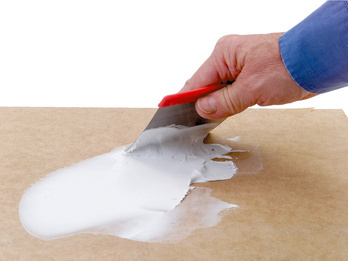
Apply VAKU acrylic filler using a steel joint knife at temperatures no lower than +5 °C. The surface must be clean, stable and dry. Maximum coat thickness: approx. 2 mm. Absorbent surfaces, steel surfaces and untreated wooden surfaces must be primed beforehand. Wear a fine-dust mask when sanding. Thoroughly remove all dust from sanded surfaces before applying wallpaper or paint.
Select RAL-colour code
!! NOTE: On-screen visualisation of the colour differs from real colour shade!!